![Sibanye Gold [logo]](https://reports.sibanyestillwater.com/2014/img/logo.svg)
![Sibanye Gold [logo]](https://reports.sibanyestillwater.com/2014/img/logo-print.svg)
Managing risk, identifying opportunities
Our Board is responsible for risk governance and sets the tone for overseeing the entire risk-management process. In 2014, a Risk Committee was established to increase the focus on risk management. This Risk Committee has been authorised to implement and ensure compliance with appropriate risk-management protocols and processes.
RISK MANAGEMENT OVERSIGHT, RESPONSIBILITY AND GOVERNANCE
Sibanye’s Risk Management Policy, strives to manage risk effectively to protect the Group’s assets, stakeholders, environment and reputation to ensure that we achieve our business objectives. The aim of the risk management framework is to achieve a fuller understanding of the reward/risk balance and seek to reduce the likelihood and consequences of adverse effects to levels that are within our risk appetite/tolerance, and to achieve continuous improvement in the management of our risks, thereby enhancing the degree of certainty of achieving our objectives.
The Board believes that Sibanye’s risk-management policies, practices and management systems are sound, well-established and entrenched at the operations. The Group has implemented an Enterprise Risk Management guideline, which is aligned with the ISO 31000 international risk-management standard and the governance principles enshrined in King III.
Our objectives are:
- to identify, assess and manage risks in an effective and efficient manner;
- to make decisions based on a comprehensive review of the reward-to-risk balance;
- to provide greater certainty on the delivery of objectives; and
- to fulfil corporate governance requirements.
Underpinning these objectives, the Group has implemented the following actions:
- introduction of a comprehensive and systematic risk-assessment and reporting process across the organisation;
- creation of an environment where risks are controlled and mitigated within the accepted and approved Sibanye risk-tolerance levels;
- integration of the outputs of specialist risk functions to provide an informed view of the risks associated with the business activities;
- achieved appropriate risk-management awareness in business processes with emphasis on risk management instilled in all associated stakeholders;
- fostered a culture of continuous improvement in risk management by aiming to achieve best practice standards, supported by audit and review processes; and
- creation of an appropriate risk-financing programme based on the risk profiles developed in the assessment process.
PROCESS AND SYSTEMS
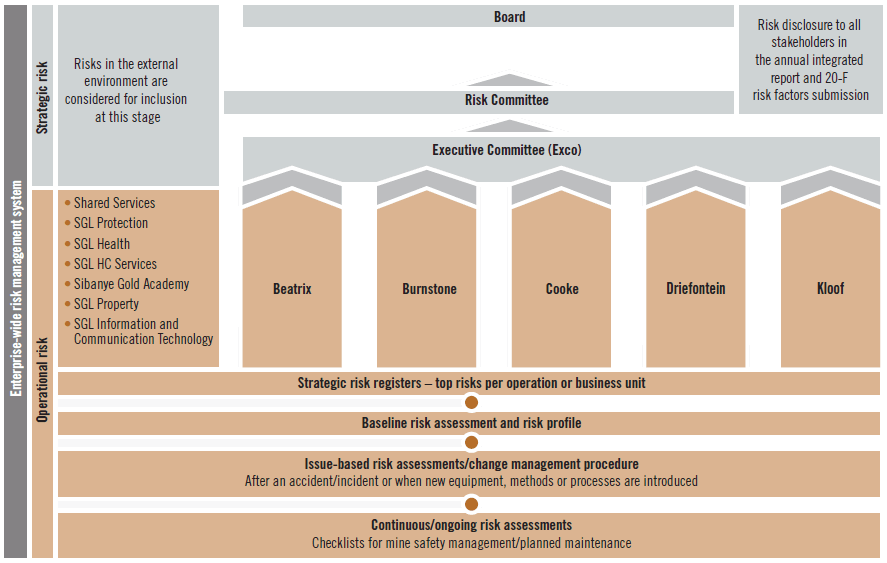
The strategic risk register maintained at corporate level is reviewed twice a year by the Risk Committee. In addition, the operations have a formal quarterly risk-review process, which follows a formalised responsibility structure and includes support services, engineering, health and safety and environmental staff – where the risk registers are discussed and updated. Should any additional risks be identified, plans to address them are implemented. At the operations, risk assessment is a daily activity and work areas are assessed daily in terms of their compliance with the requirements.
At corporate level, the risk owner is represented on the Executive Committee (Exco). Responsibility for mitigating risks is given to representatives of relevant departments. Emphasis is placed on the business taking ownership of risk.
The Internal Audit Department is responsible for conducting annual audits on mitigation actions, and reports four times annually to the Audit Committee.
COMBINED ASSURANCE
The combined assurance process is embedded within Sibanye’s operations. The approach is based on the application of three levels.


| Risk | Mitigation | |
|---|---|---|
1 |
Labour relations/wage negotiationsSibanye’s operations and profits may be adversely affected by disruptions arising from strikes and union activity, especially during the upcoming wage negotiations. |
|
2 |
Power constraints and cost increasesPower stoppages, fluctuations and usage constraints may force Sibanye to halt or curtail operations, and increased power cost increases may adversely affect Sibanye’s operational results. |
|
3 |
Failure to deliver on operational and financial plansDue to the nature of deep level gold mining and poor labour productivity, operational production targets may not be met, which will affect the profitability of Sibanye’s operations and the cash flows generated by those operations. |
|
4 |
Profitability of Cooke operationsTo the extent that Sibanye seeks to expand through acquisitions, it may experience delays or other issues in executing acquisitions or managing and integrating the acquisitions with its existing operations. |
|
5 |
Mine accidents and seismicity-related incidentsDue to the nature of deep-level gold mining, industrial and seismicity accidents may result in operational disruptions, such as stoppages, which could result in increased production costs as well as financial and regulatory liabilities. |
|
6 |
Non-delivery on the Minerals and Petroleum Resources Development Act, Mining Charter, and social and labour plans (SLPs)Sibanye’s mineral rights are subject to legislation in terms of the Minerals and Petroleum Resources Development Act, the Mining Charter, and social and labour plans. Non-delivery could result in loss of the mining licence and impose significant costs and burdens. |
|
7 |
Volatility in gold price and exchange ratesChanges in the market price of gold, which can fluctuate widely, affect the profitability of Sibanye’s operations and the cash flows generated by those operations. Because gold is generally sold in US dollars, while Sibanye’s production costs are primarily in Rand, Sibanye’s operating results and financial condition may be materially harmed if there is a material adverse change in the value of the Rand. |
|
8 |
Erosion of All-in cost margins as a result of rising mining input costsIncreases in the prices of production inputs may have a material adverse effect on Sibanye’s operations and profits. Our business is subject to high fixed costs, which may impact profitability. |
|
9 |
Theft of product, gold-bearing material explosives and copper, as well as illegal miningTheft of gold and production inputs, as well as illegal mining, occur on some of Sibanye’s properties. These activities are difficult to control, can disrupt Sibanye’s business and could expose Sibanye to liability. |
|
10 |
Aging infrastructureDue to aging infrastructure at our operations, unplanned breakdowns and stoppages may result in production delays, increased costs and industrial accidents. |
|