
Materials and waste
G4:
- G4-EN1
- Materials used by weight or volume
- G4-EN22
- Total water discharge by quality and destination
- G4-EN23
- Total weight of waste by type and disposal method
- G4-EN24
- Total number and volume of significant spills
- G4-EN33
- Significant actual and potential negative environmental impacts in the supply chain and actions taken
MATERIALS USED, MANAGING WASTE
Sibanye, in the course of its normal business, mines significant amounts of gold-bearing ore and associated waste rock. Sibanye’s emphasis on quality mining ensures that the Group removes as little waste rock as possible and focuses on removing only the gold-bearing reef.
Further, the reprocessing of surface gold-bearing material supplements the processing stream and has a positive environmental impact. The diagram below illustrates the volumes of materials involved.
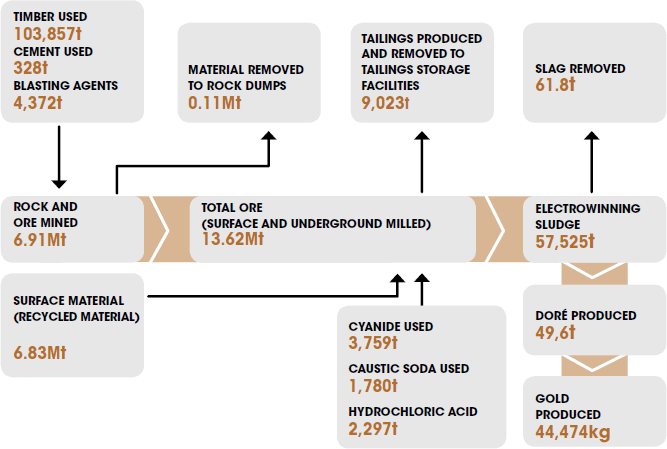
Minimising the use of materials makes good business sense, and Sibanye actively measures and monitors their use.
In addition to being ISO 14001-compliant, Sibanye’s timber supplier is compliant with the Forest Stewardship Council, which is an international not-for-profit, multi-stakeholder organisation established in 1993 to promote responsible management of the world’s forests. Its main tools include standard setting, certification and labelling of forest products.
| 2011 | 2012 | 2013 | |
|---|---|---|---|
| Rock mined (t) | 7,839,210 | 6,306,510 | 6,905,373 |
| Surface materials used (t) | 138,149 | 116,007 | 129,861 |
| Ore processed (t) | 14,639,698 | 12,243,160 | 13,622,857 |
| Timber used (t) | 109,249 | 94,024 | 103,857 |
| Blasting agents used (t) | 5,887 | 3,031 | 4,372 |
| Cyanide used (t) | 3,224 | 3,395 | 3,759 |
| Hydrochloric acid used (t) | 2,329 | 1,837 | 2,297 |
| Lime used (t) | 14,589 | 11,861 | 13,468 |
| Cement used (t) | 1,409 | 277 | 328 |
| Caustic soda used (t) | 1,462 | 1,584 | 1,780 |
| Diesel (kl) | 5,616 | 5,519 | 6,384 |
| 2011 | 2012 | 2013 | |
|---|---|---|---|
| Mining waste (Mt) | 15.98 | 11.84 | 13.87 |
| – Tailings | 14.64 | 10.72 | 13.11 |
| – Waste rock | 1.33 | 1.11 | 0.76 |
| Waste recycled (000t) | 16.66 | 614.22 | 13.29 |
MANAGING CYANIDE
Gold is found at very low concentrations in Sibanye ores – at a minimum of around 3g/t and a maximum of around 60g/t. Hydrometallurgical extraction is the only economically viable method of extracting this gold from the ore, which involves a leaching step during which gold is dissolved in an aqueous medium, followed by the separation of the gold-bearing solution from the residues, or adsorption of the gold onto activated carbon.
After elution from the activated carbon, the gold is further concentrated by precipitation or electro-deposition. Gold is not soluble in water. For this reason, cyanide is used to stabilise gold in solution and, with oxygen, is used to dissolve the gold. Cyanide has been the primary reagent for the leaching of gold from ores since its introduction in the late 19th century.
While cyanide is less costly and potentially less harmful than other reagents with similar properties, there are risks associated with its storage and use. All of Sibanye’s mines and plants comply with the Cyanide Code. See case study: Land-use survey maps stakeholders.
Beatrix was last certified in February 2012, Driefontein in August 2012 and Kloof in December 2012.
The Group did not report any cyanide-related incidents in the past year. As a cost-cutting measure, and with the knowledge that all the necessary systems and practices are in place, Sibanye will not formally participate in the Cyanide Code in future.
ENVIRONMENTAL INCIDENTS
In 2013, Sibanye reported only one significant environmental incident, compared to one such incident in 2012. This was due to the maintenance programme incorporated into the Engineering Pragma System. The decline in Level 3 incidents can be attributed to the maintenance programme incorporated into the Engineering Pragma Management System.
This includes timeous reporting and maintenance of pipeline failure incidents, conducting thickness testing on the pipeline, installation of flow meters and daily inspection of pipes by pipe-walkers. Through these processes, pipes are identified to be either rotated or replaced ahead of failure, thereby preventing or reducing the extent of the incident.
Significant incidents are defined as follows:
- Level 3 – incidents that result in ongoing but limited environmental impact.
- Level 4 – incidents that result in medium-term environmental impact.
- Level 5 – incidents that result in long-term environmental impact.
Of Sibanye’s environmental incidents, one incident was a Level 3 incident (the rest were classified as Level 1/ Level 2 incidents). As such, there were no Level 4 or Level 5 incidents. The single significant environmental incident (Level 3) related to a slimes spillage at the Driefontein Operation.
Significant incident report
- Date
- 17 September 2013
- Level
- Level 3
- Operation
- Driefontein
- Description
- Pipeline No 61 to the No 1 tailings storage facility (TSF) burst behind Pomolong Village
- Volume
- Approximately 4,500m³
- Material
- Waste: Tailings slurry from the gold plant metallurgical process. Tailings contain harmful sulphate and uranium.
- Impact
- Uncontrolled discharge of tailings caused degradation of soil and water quality. Tailings spills have potential to impact on the quality of surface water and groundwater, as well as soil.
- Remediation
undertaken - As an emergency measure, the affected pipe segment was temporarily clamped to minimise further spillage from the pipe segment. The spill was allowed to dry in order to facilitate the clean-up process. The incident was reported to the DWA and the DMR. The Sustainable Development Department has investigated the incident, and the investigation report was submitted to the DWA on 26 September 2013 as per the water use licence (WUL) condition.